
Official diving organization
The development of diving through history and key moments that shaped the modern diving sport in Montenegro

Dr. Nikola Babac
Diving Association of Montenegro
Professional diving on the Montenegrin part of the Adriatic coast has a relatively long tradition. As Dr. Stracimir Gošović (1927–2018) writes in his book “DIVING IN SAFETY”, it is impressive that in the period from 1927 to 1941, 7 diving courses for officers, 11 for non-commissioned officers and 24 courses for sailors were held in the former Royal Navy. The divers of the Royal Macedonian Navy were trained in Tivat by “Pan” Polak, who also worked in this activity in the Austro-Hungarian Republic. The submariners were equipped with Davis apparatus, intended for abandoning a sunken submarine, and the courses lasted from 4 to 12 months.
Medical support for courses and major underwater operations was provided by doctors from the hospital in Meljine and the garrison clinics in Boka Kotorska, among whom B. Pavlović, Z. Vojvodić and especially N. Babac stood out. After World War II, Dr. Nikola Babac participated in the medical support for major underwater operations, taught maritime hygiene in naval schools, and in 1953 published the book “Diving and Underwater Operations”. This book played a pioneering role in the training of civilian and military divers, as well as doctors who provided divers with medical support.
In 1933, the Royal Navy acquired a stable, two-compartment “Siebe Gorman” recompression chamber for the treatment of divers, which was stationed at Meljine, where divers were treated for decompression sickness. In the first post-war years, this chamber was taken over by the Brodospas company in Rijeka, Republic of Croatia.
Diving Association of Montenegro
Amateur, sports and recreational diving, mainly motivated by underwater research, appeared relatively early, almost simultaneously with the coasts of Italy and France. As early as 1953, the Association of Sport and Fishing Societies of Yugoslavia was founded, which later grew into the Association for Sport Fishing and Underwater Activities, within which numerous centers and clubs for underwater research developed.
The first underwater activity clubs were formed in the Socialist Republic of Montenegro in 1963. With modest equipment, not much could be achieved, but in 1967, there was a significant development of underwater activities and sport fishing, contributed to by the establishment of the Association for Underwater Activities and Marine Sport Fishing of the Socialist Republic of Montenegro.
In 1989, the Diving Detachment was formed at the Republic Headquarters of the Territorial Defense of the Republic of Montenegro, mainly composed of divers from the Diving Club "Nikšić", led by Vesko Mijajlović. In 1992, this detachment received the "September 18" award, which is awarded annually on the day of the liberation of Nikšić.

Members of the Diving Detachment of the Republic
Headquarters of the Territorial Defense of the Republic of Montenegro
on the shore of Lake Krupac in Nikšić
Diving Association of Montenegro
After the abolition of the Territorial Defense of the Republic of Montenegro, in 1993, the Diving Unit was established within the Ministry of Internal Affairs, within the Special Anti-Terrorist Unit, which was led by Vesko Mijajlović until 2004. The unit was awarded the Order for Contribution to Security by the President of the Federal Republic of Yugoslavia for its many years of achievements.
The Diving Association of Montenegro (RSCG) was founded in 1994, and its founders were the Diving Club "Nikšić" from Nikšić, the Diving Club "Gorica" from the then Titograd, the Diving Club "Južno More" from Bar and the Diving Club "Jugole Grakalić" from Herceg Novi. The first president of the RSCG Assembly was Prof. Dr. Mihailo Burić, while the president of the association was Vesko Mijajlović.
In September 1993, in the building of the Municipality of Nikšić, the first meeting of representatives of Montenegrin diving clubs, who initiated the establishment of the Diving Association of Montenegro, was held. The meeting was chaired by Miodrag Cano Novaković, then president of the Nikšić Diving Association, and Vesko Mijajlović, diving supervisor at the same club.
The South East Europe Coordinating Council for Mine Action and Protection of the Population from Mines adopted the project for the establishment of the Regional Centre for Diver Training, Underwater Demining, Rescue and Control at Sea (RCUD) on 14 February 2002 in Ljubljana. The Government of the Republic of Montenegro adopted the decision on its establishment on 7 June 2002.
The Diving Association of Montenegro is a member of CMAS – the World Diving Federation. In sports and professional diving, the association achieves significant results that are recognized by the most eminent world organizations, and its representatives and members are winners of numerous international awards and recognitions for their work.
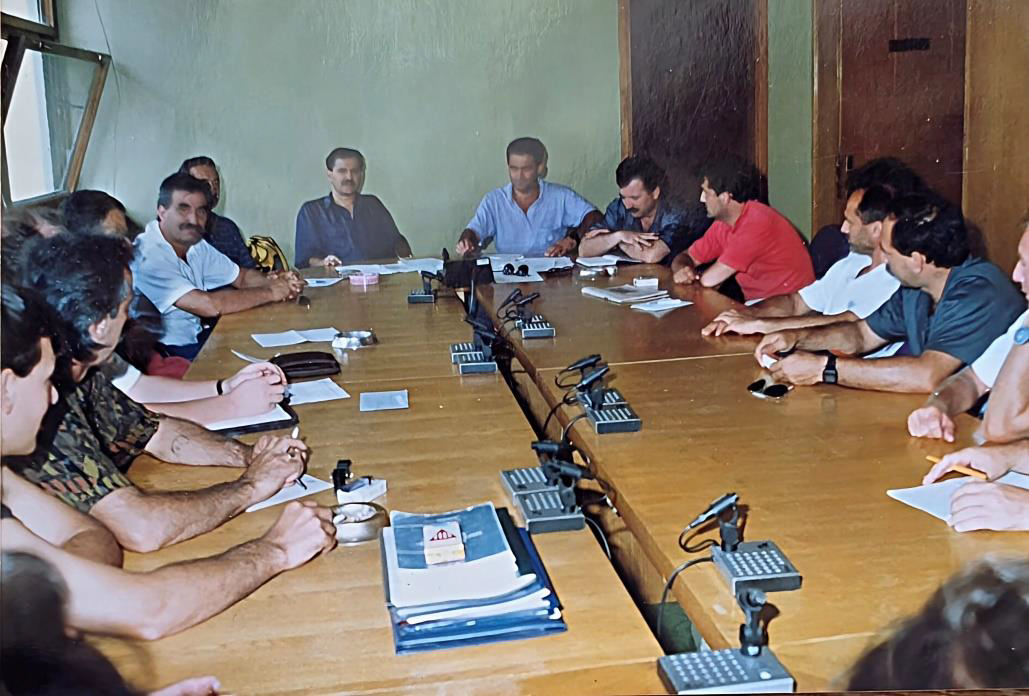
In September 1993, the first meeting of representatives of Montenegrin diving clubs, who initiated the establishment of the Diving Association of Montenegro, was organized in the building of the Municipality of Nikšić. The meeting was chaired by Miodrag Cano Novaković, then president of the Nikšić Diving Association, and Vesko Mijajlović, supervisor.

Prof. Dr. Mihailo Burić, first president of the RSCG Assembly, and M.Sc. Vesko Mijajlović, first president of the RSCG, at the founding session of the RSCG Assembly in 1994 in Podgorica.

An archival overview of the initiative to establish a regional center for underwater demining and diver training, which confirms the importance of Montenegro as one of the key centers for the development of diving activities in the region.